
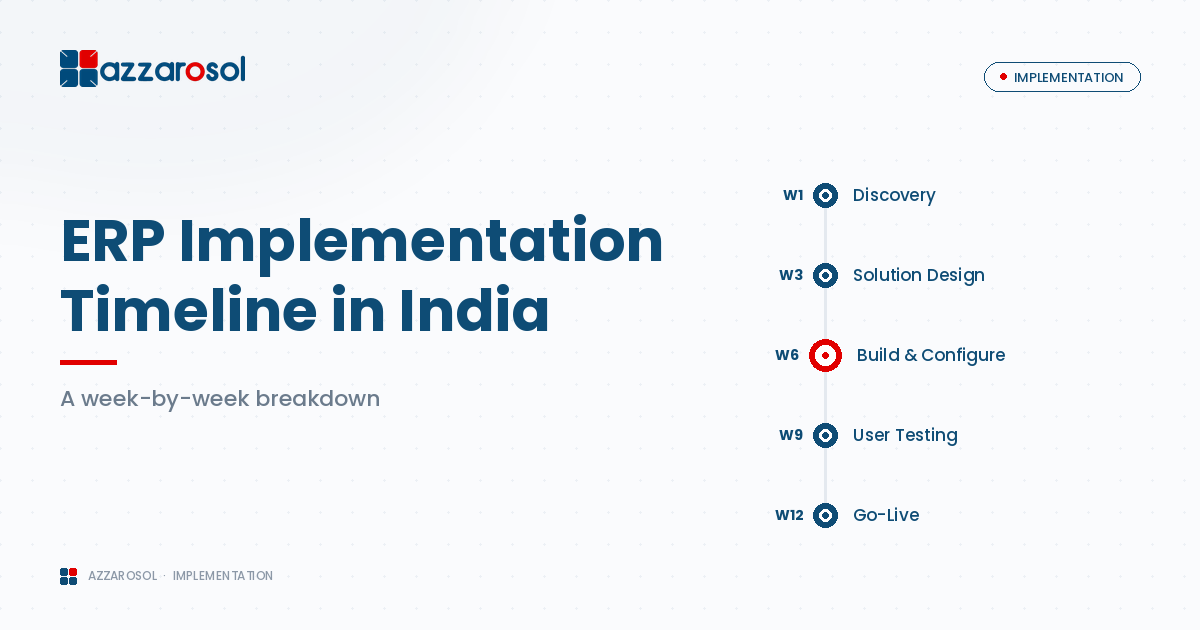
ERP implementation timeline India helps businesses plan ERP projects without delays, cost overruns, or operational risk. This guide explains the exact week-by-week ERP implementation process Indian companies should expect.
Why ERP Implementation Timeline India Needs Realistic Planning
ERP implementation impacts every core business function. In India, timelines are influenced by:
- GST and statutory compliance requirements
- Multi-location operations
- Limited internal IT bandwidth
- Dependency on external ERP partners
Organizations that work with an experienced ERP consulting partner in India like Azzarosol typically avoid the most common timeline mistakes because expectations are set correctly from day one.
Without a clear ERP implementation timeline, businesses often face:
- Budget overruns
- Extended go-live cycles
- Poor user adoption
- Compliance-related rework
What Determines the ERP Implementation Timeline India Companies Experience
Every ERP project follows a different ERP project timeline India-wide, but these factors consistently affect duration.
1. Company Size and Complexity
- ERP implementation timeline for SMEs in India is shorter due to fewer workflows
- ERP implementation timeline for mid-sized companies India is longer because of multi-department coordination
- Enterprises usually follow phased rollouts
2. Industry-Specific Requirements
- ERP implementation timeline in India for manufacturing is longer due to production planning and inventory control
- Distribution and logistics companies require advanced supply chain configurations
- Service businesses have simpler ERP deployment timelines
3. ERP Platform Selection
Cloud-based platforms such as Microsoft Dynamics 365 ERP reduce infrastructure setup time and offer faster scalability compared to traditional on-premise systems.
4. Customization Scope
Heavy customization increases ERP customization timeline, testing effort, and post-go-live risk.
Average ERP Implementation Duration India Companies Should Expect
If you’re asking how long does ERP implementation take in India, here’s a realistic benchmark:
- Small businesses: 8–12 weeks
- SMEs: 12–16 weeks
- Mid-sized companies: 16–24 weeks
- Large enterprises: 6–12 months
These timelines assume structured ERP project management and active business involvement.
ERP Implementation Timeline India: Week-by-Week Breakdown
Below is a week by week ERP implementation plan commonly followed in Indian ERP projects.
Week 1–2: ERP Project Planning and Requirement Gathering
This phase defines the direction of the entire ERP implementation process in India.
Key ERP implementation steps include:
- Defining business objectives and KPIs
- Identifying ERP modules
- Mapping existing workflows
- Assigning internal ERP owners
Projects that follow a structured Dynamics 365 ERP and CRM implementation approach typically experience fewer requirement changes later.
Week 3–4: ERP Solution Design and Blueprint Finalization
This phase translates business needs into a working ERP design.
Activities include:
- Process mapping inside the ERP system
- Gap analysis between standard ERP and business needs
- Finalizing ERP implementation methodology
- Locking customization scope
A strong blueprint prevents delays in later ERP implementation phases India businesses struggle with.
Week 5–6: ERP Configuration and Customization
This phase defines how the ERP system will operate day to day.
Configuration covers:
- Finance, procurement, sales, and inventory modules
- Workflow automation
- User roles and permissions
- Custom reports
Excess customization is one of the biggest reasons ERP implementation duration India projects extend beyond plan.
Week 7–8: Data Migration and ERP System Integration
Data quality directly impacts ERP system deployment success.
Key tasks include:
- Cleansing legacy data
- Migrating masters and historical transactions
- Integrating ERP with banking, payroll, and GST systems
Poor data preparation is a common cause of ERP deployment timeline delays.
Week 9–10: ERP Testing Phase and User Acceptance Testing
Testing validates whether the ERP system works in real business conditions.
Testing includes:
- Functional testing across modules
- End-to-end transaction scenarios
- Compliance validation
- User Acceptance Testing (UAT)
Skipping or rushing this ERP testing phase often leads to unstable go-live.
Week 11: User Training and Change Management
ERP success depends on adoption, not just implementation.
Focus areas:
- Role-based training
- SOP documentation
- Handling employee resistance
- Preparing teams for new workflows
Organizations that plan post-go-live support through ERP managed services usually see faster stabilization.
Week 12: ERP Go-Live Process and Stabilization
This is the most critical phase of the ERP rollout timeline.
Go-live activities include:
- Final data validation
- System cut-over
- Real-time issue resolution
- Hypercare support
A disciplined ERP go-live process reduces business disruption.
ERP Implementation Schedule India: Industry-Specific Timelines
Manufacturing:
ERP implementation timeline in India for manufacturing is longer due to production planning and inventory control. Businesses operating in the manufacturing sector usually require 16–24 weeks.
Wholesale & Distribution:
Inventory and order management complexity affects the ERP project timeline for wholesale and distribution ERP implementations.
Logistics:
Companies in logistics ERP implementation need additional time for route planning and third-party integrations.
EPC:
Project-based businesses such as ERP for EPC companies often require phased rollouts.
Financial & Professional Services:
Service firms implementing ERP for financial and professional services typically complete projects faster due to minimal customization.
Common ERP Implementation Challenges Indian Companies Face
Despite planning, delays often occur due to:
- Unrealistic vendor commitments
- Weak internal ownership
- Frequent scope changes
- Poor data discipline
- Underestimating compliance complexity
Addressing these early protects your ERP project plan.
How to Reduce ERP Implementation Timeline in India
Experienced ERP teams recommend:
- Freezing requirements early
- Assigning full-time internal ERP leads
- Limiting customization
- Choosing partners with India-specific experience
- Using phased ERP implementation roadmap for complex operations
Speed comes from discipline, not shortcuts.
ERP Implementation Timeline SAP India vs Oracle vs Cloud ERP
- SAP ERP: Best for large enterprises, longer timelines
- Oracle ERP: Robust but planning-intensive
- Cloud ERP: Faster ERP deployment timeline with lower infrastructure effort
Platform choice directly impacts ERP implementation duration India companies experience.
Conclusion:
The ERP implementation timeline in India usually ranges from 8 to 24 weeks for SMEs and mid-sized companies. The timeline depends on business size, industry complexity, ERP platform, customization level, and data readiness. Manufacturing and project-based businesses often require longer timelines.
Whether you’re implementing ERP for the first time or replacing an existing system, success depends on realistic planning and the right execution partner.
If you want a customized ERP implementation schedule India-specific to your industry and company size, Azzarosol can help.
Contact Us now to plan a dependable ERP implementation timeline India organizations rely on.
1 Comment