
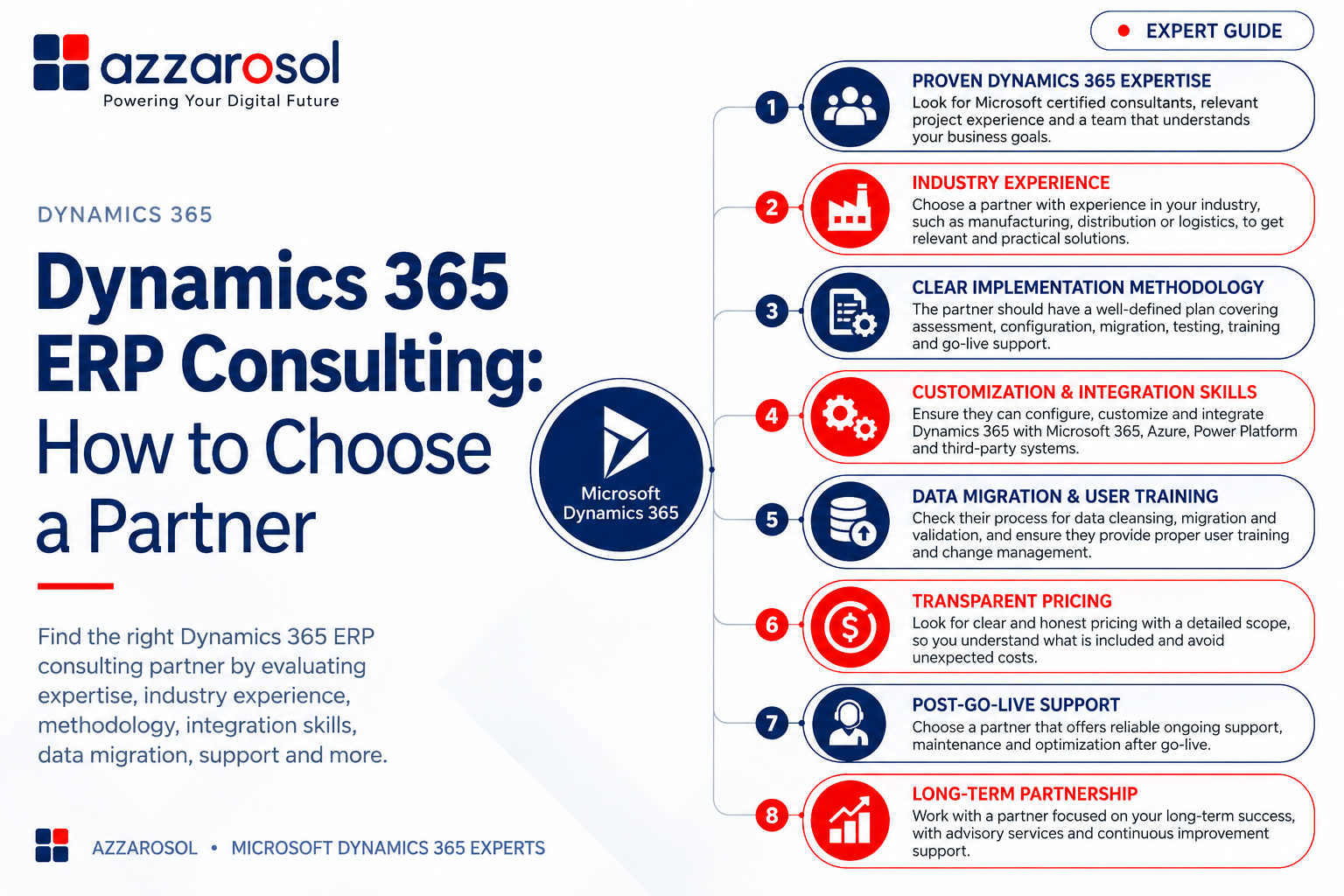
Dynamics 365 ERP Consulting helps businesses plan, implement, and optimize Microsoft Dynamics 365 based on their specific processes. Choosing the right partner can reduce implementation risks, control costs, and improve long-term ERP results.
How Do You Choose a Dynamics 365 ERP Consulting Partner?
Look for proven Dynamics 365 expertise, relevant industry experience, a clear implementation methodology, integration and migration skills, transparent pricing, and reliable post-go-live support. The right partner should understand your business goals — not just the software.
Choosing a partner should be based on evidence, not a sales presentation. Use these checks before signing a contract.
1. Check Dynamics 365 ERP Consulting Expertise
Review the partner’s Dynamics 365 expertise. Ask about Microsoft certified consultants, completed projects, team experience, and supported modules. A Microsoft Dynamics 365 partner should explain how the proposed solution fits your business instead of simply listing product features.
If you need a Microsoft Dynamics 365 implementation consultant, ask who will actually work on your project. A strong Dynamics ERP consultant should understand ERP configuration, workflow automation, ERP integration services, reporting, security, and deployment.
Also check whether the provider offers Microsoft Dynamics 365 consulting, Microsoft Dynamics ERP consulting, Dynamics 365 advisory services, Dynamics 365 consulting services, and long-term Dynamics 365 support services. This helps ensure the same team can guide the project from planning to improvement.
A reliable Dynamics 365 business consultant should also understand ERP implementation services, ERP implementation methodology, ERP implementation consultant responsibilities, and practical business management software requirements.
Work with certified experts – learn more about our certified Dynamics 365 consultants.
2. Evaluate Industry Experience
ERP needs vary by industry. A manufacturer may need production planning, inventory control, and shop-floor processes. A distributor may need purchasing, warehouse management, and order visibility. A logistics company may need stronger supply chain workflows.
Ask for similar projects, such as a Dynamics 365 implementation partner for manufacturing, Dynamics 365 ERP consulting for wholesale distribution, or Dynamics 365 ERP consulting for logistics.
Industry knowledge helps the partner understand processes faster and recommend industry-specific ERP solutions without forcing unnecessary changes.
See how we support manufacturing and distribution clients with tailored ERP solutions.
3. Review the Dynamics 365 ERP Consulting Methodology
Ask the Dynamics 365 ERP partner to explain its ERP implementation methodology.
A clear plan should cover:
- Requirements and process assessment
- ERP configuration and solution design
- ERP customization where it adds real value
- Data migration and validation
- ERP integration and testing
- User training
- System deployment and go-live
- Post-implementation support
Ask for a realistic ERP implementation timeline. Be cautious if a consulting company gives a fixed date before reviewing your data, users, integrations, and processes.
Good ERP project management should include clear responsibilities, milestones, testing stages, risk controls, and communication between business and technical teams.
Understand common pitfalls in our guide on Dynamics 365 implementation challenges.
4. Assess Customization and Integration Skills
One common ERP mistake is customizing everything. Good Dynamics 365 customization services should solve a real business need while keeping the system easier to maintain.
Ask how the partner handles Dynamics 365 configuration before recommending custom development. Review its experience with Power Platform integration, Microsoft 365 integration, Azure integration, and third-party integrations.
A capable Dynamics 365 customization and integration partner should explain what should remain standard, what needs configuration, and what truly requires customization. This can reduce future upgrade issues and ERP maintenance costs.
Also evaluate its experience with Dynamics 365 integration services, ERP integration services, ERP system integration, and Microsoft cloud ERP environments.
Learn how to avoid costly errors in our blog on top Dynamics 365 integration mistakes and how to avoid them.
5. Check Data Migration and User Training
Moving from a legacy ERP requires more than exporting spreadsheets. The partner should have a clear process for data cleansing, mapping, migration, validation, and ERP data management.
Ask:
- Which historical data should be migrated?
- Who checks data quality?
- How will migration be tested?
- What happens if records fail validation?
- How will users be trained?
User training should be based on real job roles. Finance teams, sales teams, warehouse staff, and managers do not use an ERP in the same way.
A strong ERP software consultant should also explain ERP migration, ERP implementation services, ERP testing, and user adoption in simple business terms.
Read our strategy for ERP data migration strategy preventing costly failures.
6. Compare ERP Implementation Cost and Support
When asking how much does Dynamics 365 consulting cost, avoid focusing only on the initial quote. Dynamics 365 ERP implementation cost depends on users, modules, integrations, data migration, customization, training, and project complexity.
Ask the ERP implementation partner to explain:
- What is included in the proposal?
- What is charged separately?
- How are change requests handled?
- What support is included after go-live?
- Are service levels clearly defined?
Compare Dynamics 365 managed services, Dynamics 365 migration services, Dynamics 365 upgrade services, and Dynamics 365 ERP support and maintenance services.
The same review should cover ERP support services, ERP maintenance, post-implementation support, and future upgrade requirements. A low initial price may become expensive if support is weak or services are excluded.
Explore our comprehensive post-go-live ERP support to ensure long-term success.
7. Consider Long-Term Dynamics 365 ERP Consulting Fit
Your ERP should support growth rather than become another limitation. Discuss ERP scalability, new locations, additional users, future integrations, and changing reporting needs.
Ask whether the Dynamics 365 solution partner can help with business process optimization, ERP reporting and analytics, digital transformation, and future improvements.
A good Dynamics 365 ERP partner should act as a business advisor, not just an implementation vendor. This is especially important for companies looking for cloud-based ERP and long-term Microsoft ERP partner support.
Questions to Ask a Dynamics 365 Consulting Partner
Before selecting a Microsoft ERP partner, ask:
- How many Dynamics 365 ERP implementations have you completed?
- Have you worked with companies in our industry?
- Can you provide client references?
- Who will manage our project?
- What is your ERP implementation methodology?
- How do you handle data migration and ERP testing?
- When do you recommend configuration versus customization?
- Which integrations have you delivered?
- What is included in the ERP implementation cost?
- What support is available after go-live?
These questions make Dynamics 365 consulting partner evaluation criteria easier to compare and create a practical Dynamics 365 partner selection checklist.
Businesses researching how to choose a Dynamics 365 implementation partner, how to find a Microsoft Dynamics 365 consultant, or what to look for in a Dynamics 365 partner should use the same checklist across every shortlisted provider.
Red Flags in Dynamics 365 ERP Consulting
Be cautious if a provider:
- Promises a timeline without reviewing requirements
- Gives unclear pricing
- Pushes unnecessary customization
- Cannot explain data migration
- Has few relevant examples
- Gives little detail about testing or training
- Offers no clear post-go-live support
- Cannot explain technical decisions simply
A strong ERP solution provider should be able to connect technical decisions with measurable business outcomes.
How Azzarosol Supports Dynamics 365 ERP Consulting
Azzarosol provides Dynamics 365 ERP consulting and ERP consulting services for businesses. The approach starts with business needs, processes, system gaps, integrations, data, and goals.
Whether you need a Dynamics 365 ERP consultant for small business, a Microsoft Dynamics 365 ERP consulting company, Dynamics 365 implementation services, Dynamics 365 migration and implementation services, or Dynamics 365 managed services, partner capability should match your needs.
We can also support businesses evaluating Dynamics 365 consulting services for businesses and Dynamics 365 consulting services in India, with a focus on practical implementation rather than unnecessary complexity.
The same principle applies to cloud ERP consulting: technology should follow the business process, not the other way around.
Conclusion:
The best Dynamics 365 ERP consulting partner is not necessarily the cheapest or largest. It understands your business, designs the right solution, controls implementation risk, manages integrations and migration, trains users, and provides support after launch.
Use experience, industry fit, methodology, technical skills, pricing clarity, and long-term support as your selection criteria. A partner that can explain both technology and business impact is more likely to deliver lasting value.
Before making a decision, compare partners against the same Dynamics 365 implementation partner selection criteria and review their Dynamics 365 ERP implementation best practices, references, methodology, and support model.
If you are planning a Dynamics 365 project, speak with us to assess your requirements and choose a path forward. Contact Us now for Dynamics 365 ERP Consulting support.