
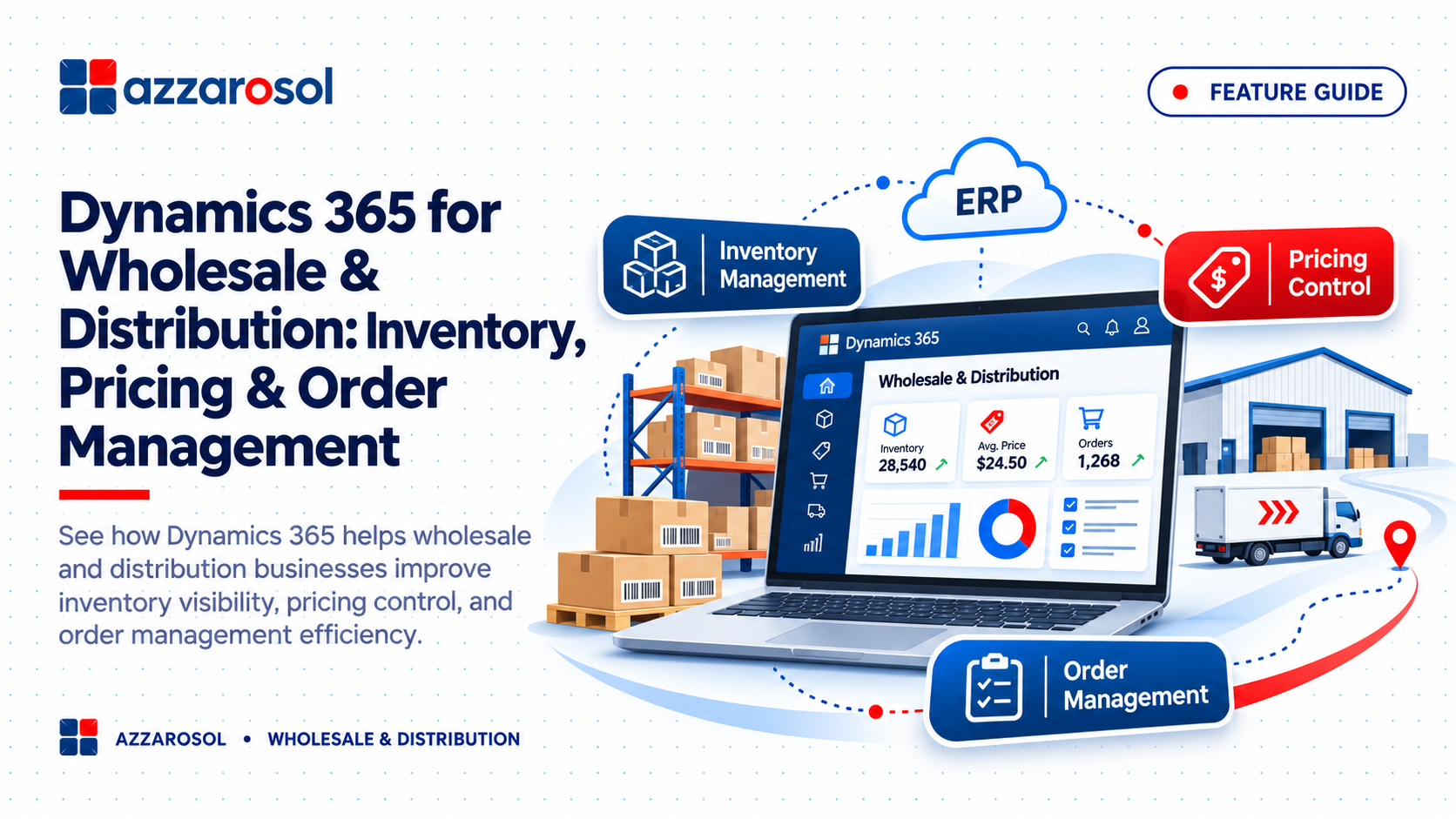
Wholesale and distribution businesses need accurate stock records, competitive pricing, and fast order processing to serve customers and protect profit margins. Dynamics 365 for Wholesale & Distribution helps businesses connect inventory, purchasing, sales, warehouse operations, and financial data through an integrated ERP system. Instead of relying on spreadsheets and separate software, distributors can manage daily operations with better control and visibility.
For growing wholesalers, even a small stock mismatch or pricing error can lead to lost sales, delayed deliveries, and unhappy customers. Microsoft Dynamics 365 provides tools to reduce these issues, improve business processes, and support growth.
Why Do Wholesale & Distribution Businesses Need Dynamics 365?
Many distributors still use separate systems for inventory, accounting, purchasing, and sales. This makes it difficult to get a clear view of business performance.
Common challenges include:
- Poor inventory visibility: Teams cannot see accurate stock levels across different warehouses.
- Pricing errors: Different customers receive different prices, discounts, and credit terms.
- Manual order processing: Sales teams spend time entering orders and correcting data.
- Delayed deliveries: Poor coordination between warehouses, sales, and transport teams affects fulfillment.
- Limited reporting: Business owners struggle to get accurate sales, stock, and profit reports.
A modern ERP system for wholesale business operations brings these processes together. Microsoft Dynamics 365 ERP solutions connect key departments and help teams work with more reliable information.
How Does Dynamics 365 Improve Inventory Management?
Inventory is one of the biggest concerns for wholesale distributors. Holding too much stock increases storage costs, while keeping too little can lead to missed orders. Dynamics 365 inventory management helps businesses maintain better control over stock movement, availability, and replenishment.
1. Real-Time Inventory Visibility
Dynamics 365 provides real-time inventory visibility across supported locations and operations. Teams can check available quantities, review stock movements, and make better decisions before confirming customer orders.
Key capabilities include:
- Track stock levels across multiple warehouses.
- Monitor incoming and outgoing inventory.
- Review available, reserved, and on-order quantities.
- Reduce manual stock updates and record mismatches.
This makes it easier to improve stock availability management and reduce unnecessary purchasing.
2. Multi-Warehouse Inventory Tracking
Distributors operating from several locations often struggle to understand where products are stored and when stock needs to move.
Dynamics 365 supports multi-warehouse inventory tracking, helping teams manage stock transfers, warehouse locations, and inventory movements.
For example, if a customer places a bulk order at one branch, the sales team can review stock availability at other locations before promising a delivery date.
3. Demand Planning and Inventory Replenishment
Poor demand planning can create two problems: excess inventory and stock shortages. Dynamics 365 supports inventory forecasting and replenishment planning so businesses can make informed purchasing decisions.
Businesses can use inventory data to:
- Identify products with high and low demand.
- Plan purchase orders based on stock requirements.
- Monitor inventory turnover ratios.
- Reduce slow-moving and excess stock.
For businesses asking how to improve inventory accuracy in wholesale distribution, connecting purchasing, sales, and stock records is an important starting point.
How Does Dynamics 365 Simplify Pricing Management for Distributors?
Wholesale pricing is rarely the same for every customer. A distributor may offer different rates based on order quantity, customer agreements, product categories, or promotional terms.
Dynamics 365 pricing management helps businesses maintain better control over these pricing rules.
Customer-Specific Pricing and Bulk Discounts
With the right configuration, businesses can manage customer-specific pricing, discounts, and volume-based price agreements.
For example, a distributor may sell 50 units of a product at one rate and offer a lower per-unit price for orders of 500 units. Sales teams can apply approved pricing rules instead of checking multiple spreadsheets.
Better Cost and Profit Margin Control
Pricing decisions should consider more than the purchase price. Businesses also need to account for transportation, storage, handling, and other expenses.
Dynamics 365 can support:
- Product cost and selling price tracking.
- Discount and price agreement management.
- Landed cost management in applicable supply chain configurations.
- Financial reporting and analytics.
This helps managers review product profitability and improve their product pricing strategy without depending on disconnected records.
How Does Dynamics 365 Improve Wholesale Order Management?
Manual order entry can slow down sales teams and create mistakes in product quantities, prices, and delivery details. Dynamics 365 order management helps connect sales orders with inventory and purchasing information.
Automated Sales Order Processing
Businesses can manage sales orders from order entry through fulfillment and invoicing. Depending on the selected solution and configuration, teams can improve automated order processing and reduce repeated data entry.
Important capabilities include:
- Create and manage customer sales orders.
- Check product availability before confirming orders.
- Apply approved pricing and discounts.
- Monitor order status and outstanding quantities.
- Coordinate sales and warehouse activities.
Businesses looking to improve their Dynamics 365 ERP and CRM implementation can also consider how sales and operational processes should work together.
Better Bulk Order Management and Fulfillment
Bulk order management is especially important for distributors handling large quantities and frequent repeat orders.
Dynamics 365 helps teams coordinate stock availability, order commitments, and warehouse activities. This can reduce avoidable backorders and improve customer order fulfillment.
For example, if a customer orders products that are not fully available, the team can review available stock and expected replenishment before confirming the delivery plan.
How Does Dynamics 365 Supply Chain Management Support Warehouse Operations?
Inventory control is only one part of distribution. Businesses also need efficient picking, packing, dispatching, purchasing, and supplier coordination.
Dynamics 365 Supply Chain Management provides advanced capabilities for businesses with more complex warehouse and supply chain needs.
Its capabilities can support:
- Warehouse operations management: Organize receiving, storage, picking, packing, and dispatching.
- Barcode inventory management: Improve stock identification and movement tracking.
- Batch and serial number tracking: Track products that require lot-level or serial-level control.
- Purchase order management: Monitor supplier orders and incoming stock.
- Supplier management: Improve visibility into procurement and supplier activities.
These capabilities help distributors improve warehouse efficiency and understand how Dynamics 365 improves supply chain visibility across business operations.
Dynamics 365 Business Central vs. Supply Chain Management: Which Is Better for Distributors?
Choosing the right ERP depends on business size, warehouse complexity, and operational requirements.
Dynamics 365 Business Central is suitable for many small and medium-sized distributors that need integrated financial management, sales, purchasing, inventory, and reporting.
Dynamics 365 Supply Chain Management is better suited to businesses with more advanced supply chain, warehouse, procurement, and inventory planning requirements.
When evaluating the best Microsoft Dynamics 365 ERP for wholesale distribution, consider:
- Number of warehouses and business locations.
- Monthly sales and order volumes.
- Product tracking requirements.
- Pricing and discount complexity.
- Integration with existing business systems.
- Future expansion plans.
For Dynamics 365 for wholesale and distribution companies in India, the right choice should also support local business processes, tax requirements, and reporting needs.
What Should You Consider Before Dynamics 365 Implementation?
Selecting ERP software is only the first step. Successful Dynamics 365 implementation for wholesale distribution businesses requires proper planning.
Before starting, businesses should:
- Review existing processes: Identify problems in inventory, pricing, purchasing, and order management.
- Define business requirements: Decide which features and modules are needed.
- Clean existing data: Prepare accurate product, supplier, customer, and inventory records.
- Plan integrations: Connect relevant accounting, warehouse, CRM, and other business systems.
- Train employees: Help teams understand the new workflows.
- Arrange post-go-live support: Monitor system performance and resolve issues.
Working with an experienced Microsoft Dynamics 365 implementation partner can help avoid unnecessary customization, reduce implementation risks, and improve user adoption.
Businesses can also consider Dynamics 365 managed services and support to maintain system performance and get ongoing assistance after implementation.
Conclusion:
Managing inventory, pricing, and customer orders through separate systems can create costly problems for wholesale distributors. Dynamics 365 for Wholesale & Distribution brings these important business processes together, helping companies improve stock visibility, manage customer-specific pricing, process bulk orders, and coordinate warehouse operations.
The best ERP solution is not simply the one with the most features. It is the one that fits your current operations, solves your daily challenges, and supports future growth.
Azzarosol helps businesses with Microsoft Dynamics 365 ERP consulting, implementation, integration, and ongoing support.. If your distribution business is facing inventory mismatches, pricing errors, or delayed order fulfillment, the right ERP strategy can make a real difference.
Contact Us now to discuss your Dynamics 365 for Wholesale & Distribution requirements and find the right ERP solution for your business.